Convent of the Order of Christ, Tomar - Replacement of the Pillar in the Procurators’ Hall
When engineering has to achieve the impossible… without anyone noticing.
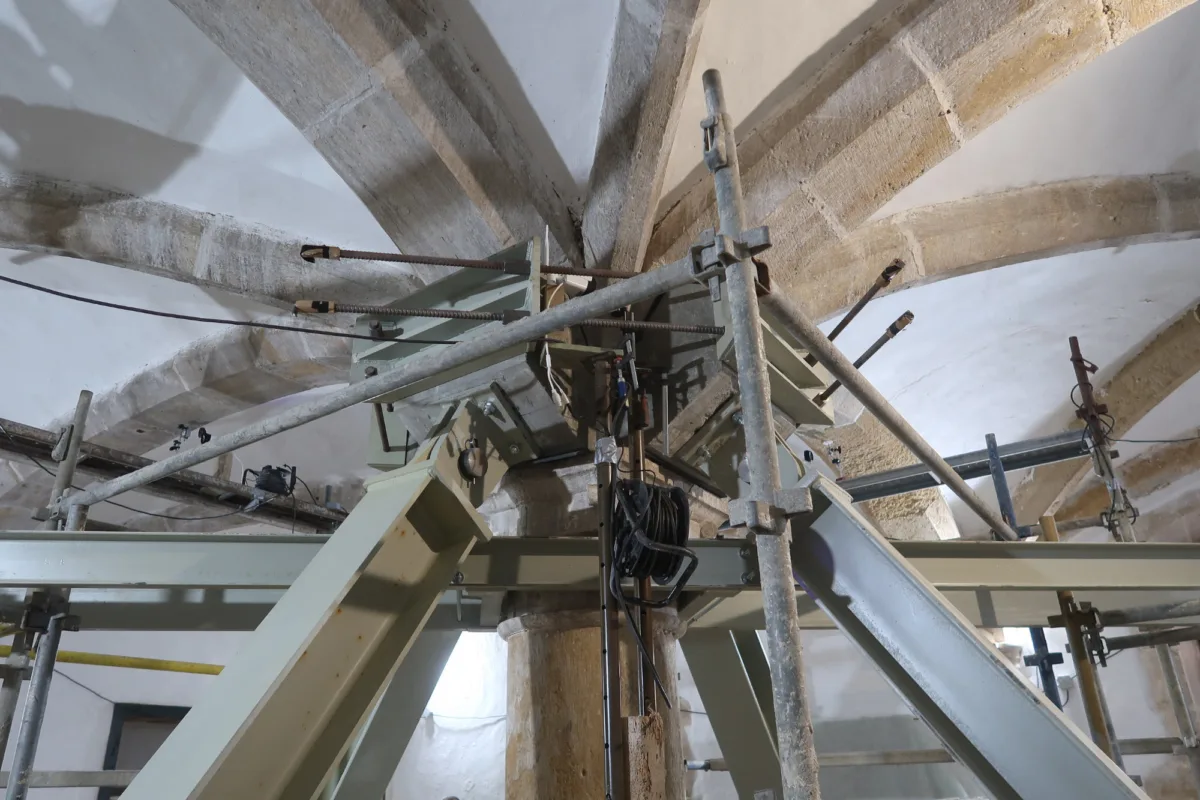
At the Convent of Christ in Tomar, one of Portugal’s most emblematic monuments and a UNESCO World Heritage Site, NCREP faced a rare, delicate and absolutely critical challenge: replacing a structural stone pillar that supported vaults, walls and entire floors, without causing any damage to the historic building.
In practical terms, it was like changing the tyre of a rare car… without switching off the engine and without allowing the slightest jolt.
The central pillar of the Procurators’ Hall, a key element in the building’s stability, showed advanced deterioration: significant material loss, extensive vertical cracking and a critical reduction in load-bearing capacity. The inspection and technical diagnosis carried out by NCREP demonstrated that replacement was not merely necessary, it was inevitable.
But how do you replace a pillar that has supported centuries of history?
An invisible yet decisive solution
The answer lay in the development of a fully custom made system and methodology, designed specifically for that site, that geometry and that heritage context.
NCREP designed an active shoring system capable of:
- progressively and safely taking over the full load of the pillar,
- ensuring the permanent stability of the vaults and overlying elements,
- allowing the removal and replacement of the pillar without interruptions, deformations or damage.
All of this was supported by a real-time monitoring system, controlling millimetric displacements in the arches, the capital and the surrounding structure throughout every phase of the operation.
Only when the structure was fully “under load” on the new system, much like a car safely supported by a jack, was it possible to remove the original pillar and install the new one, made of carefully selected limestone, prepared to ensure durability, material compatibility and protection against moisture.
Engineering at the service of heritage
The final result is invisible to visitors to the Convent of Christ. And that is, precisely, the greatest proof of success.
This intervention exemplifies what defines NCREP’s work:
- decisions grounded in rigorous diagnosis,
- highly complex structural engineering,
- absolute respect for international best practices in heritage conservation,
- effective, discreet and reversible technical solutions.
When history cannot stop, engineering must be silent, precise and entirely reliable. That is where NCREP operates.